


How to Plan Your Week: Making Room for Meals, Work and Everything In Between
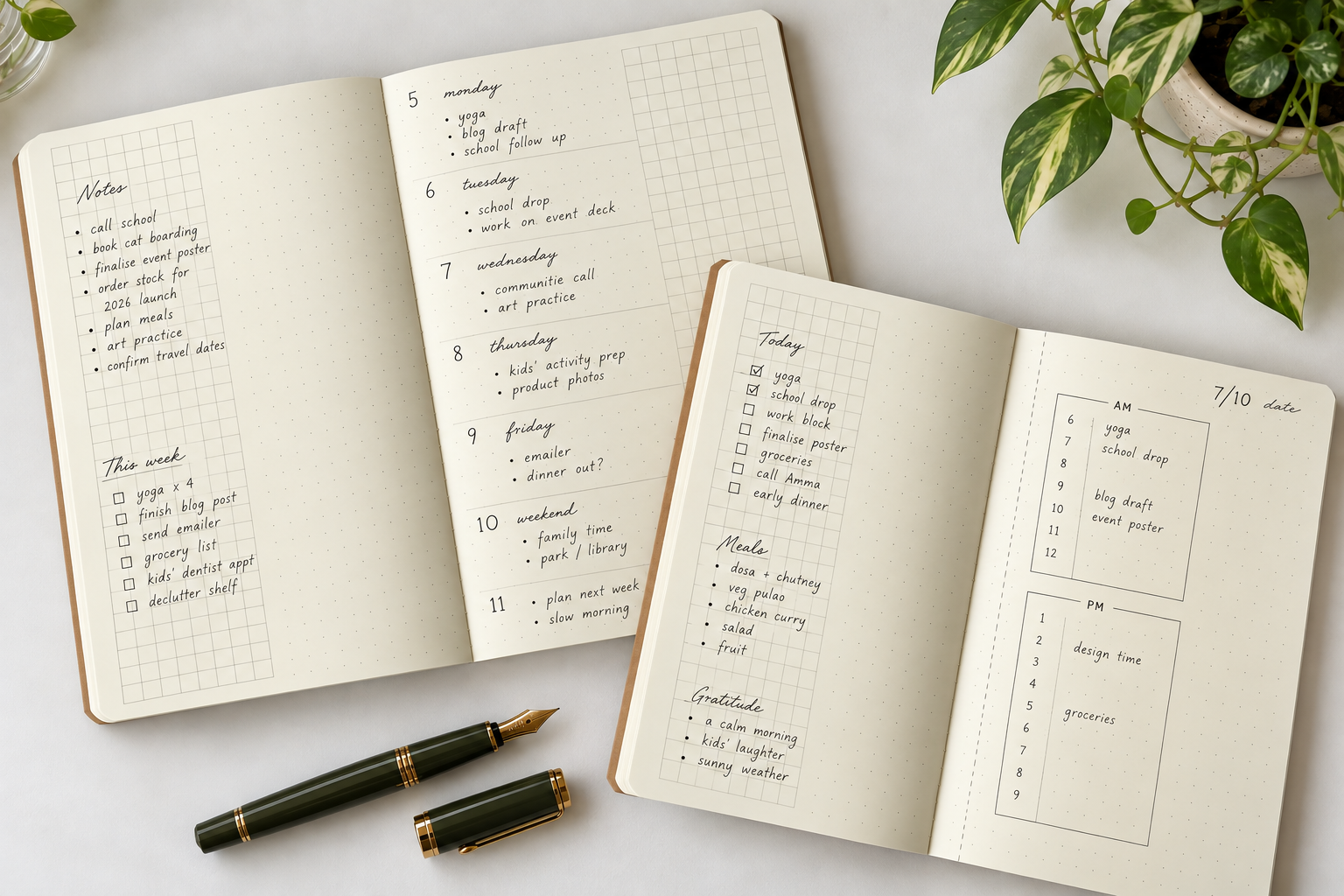
A week can look surprisingly manageable when we look at it one day at a time.
Monday has its meeting. Tuesday has an appointment. Wednesday seems fairly open. There is something to finish by Friday, groceries to buy at some point, perhaps a dinner with friends, a family commitment, a workout you would like to fit in, and a few things that have been sitting on your mind for longer than they should.
None of it sounds particularly overwhelming on its own.
And yet, by Thursday, the week can feel as though it has somehow filled itself.
Perhaps that is because we often plan the visible parts of a week without planning the space around them.
We write down meetings and deadlines. We remember appointments. We add the important things to our calendars. But what about dinner? The grocery run? The commute? The hour you need after a long day before you can think about anything else? The laundry that somehow needs to happen. The quiet Sunday you thought you would have.
A week is made up of more than the things that belong on a calendar.
Planning your week is not only about deciding what you will do. It is about seeing what the week actually needs.
Start by Seeing the Week You Already Have

There is a temptation to begin weekly planning by asking what we want to accomplish.
What should I get done this week? How much can I fit in? What goals do I need to move forward?
These questions aren’t necessarily unhelpful, but they can make a week feel like a container waiting to be filled.
A gentler place to begin is with what is already there.
Look at the week ahead before adding anything to it. Are there meetings that cannot move? An appointment on Wednesday afternoon? A family dinner? A school event? A day when you need to travel across the city? A deadline at work? Something you promised someone you would do?
Put those things down first. Then look at the spaces between them. This is often where the real shape of a week begins to appear.
You may notice that Tuesday isn’t actually as free as it looked. There is a meeting in the morning, an appointment in the afternoon and a long commute between the two. You may notice that Thursday is relatively quiet. You may realise that Saturday already has two commitments and probably isn’t the ideal day to schedule everything else you haven’t managed during the week.
This kind of weekly planning is less about controlling the days and more about seeing them clearly. The week doesn’t need to become perfectly organised. You simply want to know what you are working with.
Not Everything Needs to Be Scheduled
Once the fixed parts of the week are visible, there is a second temptation: to fill all the remaining spaces.
A free hour becomes an opportunity. A free evening becomes another task. Saturday morning becomes the time to catch up on everything that didn’t happen Monday to Friday. Before long, a week with plenty of empty space can become a week with no breathing room at all.
There is a difference between having time available and having time available for something. Sometimes an empty evening is useful precisely because it has nothing assigned to it. It might become dinner with a friend. It might become a walk. It might become an early night. It might become the hour when you finally read the book that has been sitting beside your bed. Or nothing much might happen. That is allowed too.
When we plan, we can become so focused on making use of time that we forget that rest, transition and idleness are also part of living. This doesn’t mean leaving everything unplanned. It simply means resisting the idea that every available space needs to earn its place.
A little empty space can make a busy week feel very different. It gives plans somewhere to move when something unexpected happens. And unexpected things are part of most weeks. A meeting runs late. Someone needs help. The traffic is worse than expected. A delivery arrives when you’re in the middle of something. A family plan changes. You wake up tired.
A week with no room in it has very little flexibility.
A week with some space can absorb a surprise without immediately becoming stressful.
Meals Are Part of the Plan Too

Food is one of those things that can quietly take up a great deal of time.
Not just eating, but deciding what to eat, checking what is at home, buying groceries, ordering something, preparing ingredients, cooking, cleaning up and figuring it all out again the next day.
And yet meals are often left outside our idea of weekly planning.
We plan the meeting. We plan the workout. We plan the deadline. Then Wednesday evening arrives and we are standing in front of the kitchen wondering what dinner is going to be. Thinking about meals as part of the week doesn’t have to mean creating a detailed meal plan.
It can be as simple as looking ahead. Which days are likely to be busy? When will you actually have time to cook? Is there a day when eating out makes more sense? What needs to be bought before the week begins? Are there things already in the kitchen that need using?
In an Indian household, this can be particularly useful because meals may also sit alongside family routines, school timings, work schedules and household responsibilities. A week isn’t simply a sequence of individual appointments. It is a network of things that affect one another.
If Wednesday is a particularly long day, perhaps dinner doesn’t need to become another decision waiting for you at 8 pm. If Sunday is quieter, perhaps that is when groceries or some basic preparation happens.
The point isn’t to make every meal predictable. It is to make the invisible work of feeding ourselves a little more visible. Sometimes that alone makes a week feel lighter.
And there is something worth remembering here: planning a meal is not less important than planning a meeting simply because it isn’t written on a work calendar. Both take time. Both take energy. Both belong to the week.
Work Has a Place, But It Doesn’t Have to Take the Whole Week
Work can easily expand to fill whatever space we give it.
If we have a deadline on Friday, Monday can become preparation for Friday. Tuesday becomes catching up from Monday. Wednesday becomes worrying about Thursday. And by Friday, there is a strange feeling that the entire week has belonged to work.
Weekly planning can help by giving work a shape.
Instead of writing down a long list of everything you could possibly do, look at what genuinely needs attention this week. There may be one important piece of work that needs uninterrupted time. There may be smaller tasks that can be grouped together. There may be emails that don’t need to be answered the moment they arrive. There may be things that would be nice to finish but can wait.
This is where a weekly planner can be more useful than a daily list.
A daily list tells you what is in front of you. A weekly view lets you step back far enough to see what belongs where. You might realise that you have scheduled three demanding tasks on the same day simply because each seemed important when you wrote it down. You might move one to Thursday. You might notice that Friday is already full and decide not to add anything unnecessary to it. You might see that Tuesday morning is your quietest part of the week and protect it for work that requires concentration.
The plan doesn’t have to dictate your day.
It can simply help you notice the difference between what needs doing and what needs doing now.
Make Room for Everything In Between

Some of the most important parts of a week are the things we rarely think of as planning.
Getting to places. Calling someone back. Buying groceries. Paying a bill. Putting away laundry. Making dinner. Tidying up. Meeting a friend. Taking a break between two demanding things.
These aren’t particularly glamorous tasks, but they have a way of appearing whether we plan for them or not. When they aren’t acknowledged, they can create the feeling that the week is somehow more demanding than it looked on paper. This is why a useful weekly plan needs some awareness of the in-between.
If you have an early meeting, what does the morning around it look like? If you have an evening commitment, when will dinner happen? If Saturday is filled with errands, is it really also the right day to plan a major household project? If you’ve had several intense days at work, do you actually have the energy for a social plan on Friday night?
These aren’t productivity questions. They are questions about reality. Time and energy are related, but they aren’t the same thing.
You may technically have two free hours in the evening and still not have two useful hours after a long day.
A good weekly plan makes room for this difference.
At Decluttercat, we often think about planning in terms of making space rather than filling it. A page can hold the commitments that matter without needing to account for every minute. Sometimes the most useful thing a plan can show us is not what else we can fit in, but where we might need to leave something out.
That can be a surprisingly generous way to look at a week.
Leave Some Room for the Week You Didn’t Plan
No matter how thoughtfully you plan, the week will probably surprise you. There will be a change of plans. Something will take longer than expected. You will forget something. You may wake up one morning and realise that the thing you had carefully scheduled for that day is simply not possible anymore.
This is why a weekly plan shouldn’t be treated as a contract.
It is a view of the week as you understand it right now. That understanding can change. Perhaps Monday takes longer than expected, so Tuesday needs to become lighter. Perhaps you finish something early and suddenly have an hour you didn’t expect. Perhaps a family commitment appears. Perhaps you don’t feel like doing the thing you thought you would.
The plan can move.
There is something quite freeing about allowing yourself to cross something out and rewrite it somewhere else without feeling that the original plan has failed.
A planner is not a prediction. It is a place to think about what might happen and give yourself some direction.
The actual week will always have a say.
This is also why blank space matters. A little room between commitments gives the week somewhere to breathe. It gives you somewhere to move a task when the day changes. It gives you the possibility of doing something you hadn’t anticipated.
And sometimes it simply gives you the comfort of knowing that you don’t have to be doing something every hour.
Let Your Weekly Plan Be a Conversation With Yourself

Perhaps the most useful weekly planning habit is to stop treating the week as a problem that needs solving.
Instead, look at it as a conversation.
What is already happening? What needs attention? What can wait? Where will meals fit? Where is the busiest day? Where might you need more energy? Where is there space? What would make the week feel a little easier?
These questions don’t produce a perfect schedule.
They produce awareness. And that awareness can change the way you move through the week.
You may decide that Wednesday needs to stay relatively light. You may notice that grocery shopping on Saturday is always stressful and move it to another day. You may realise that you have been saying yes to evening plans on days when you really need rest. You may discover that the work you keep postponing actually needs a protected hour rather than another item on a long to-do list.
None of this is about becoming better at squeezing things into your calendar. It is about noticing what your days can realistically hold.
Your weekly plan can be simple.
Perhaps it is a two-page spread with the days written out. Perhaps it is a list of fixed commitments beside a loose list of things you’d like to get done. Perhaps you prefer a dot-grid page where you draw only the structure you need. Perhaps you write down meals at the bottom of each day and leave the rest of the page open.
There is no need for the page to look the same every week. Some weeks may need more structure. Some may need less. The page can change because the week changes. And perhaps that is the quiet usefulness of planning. Not that it makes life predictable. Not that it helps you fit more into seven days. But that, for a few minutes, it lets you step back from the week and actually see it.
The work.
The meals.
The errands.
The people.
The commitments.
The pauses.
The things you want to make time for.
And the things that can simply wait.
A week does not have to be perfectly balanced to feel good.
It just needs to have enough room for the life that is actually happening inside it.
Plan the week you have, not the week you think you should have.