


How to Start a Bullet Journal and Make It Your Own
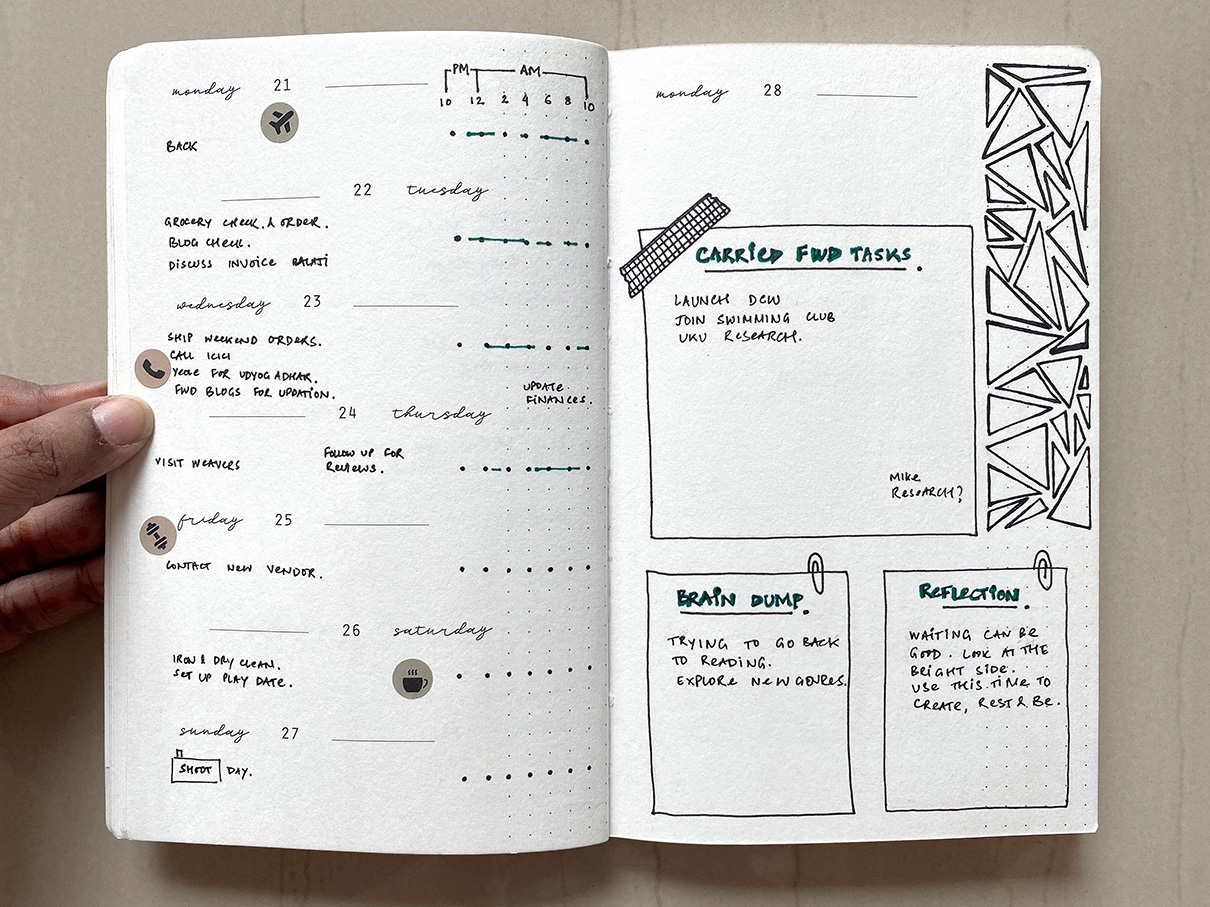
There is something very appealing about a bullet journal. If you’re figuring out how to start a bullet journal, you’ve likely felt that pull already.
One notebook. Your plans, lists, notes, ideas and reminders in one place. A way of planning that can change when your life changes. A practice that doesn’t require you to wait for Monday, the first of the month or the beginning of a new year.
And yet, if you’ve ever searched for bullet journal ideas, you may have come away with a slightly different impression.
There are beautifully illustrated monthly spreads, colour-coded calendars, habit trackers, mood trackers, reading logs, elaborate lettering and pages filled with tiny details. Some spreads are almost works of art in themselves.
They can be lovely to look at. For many people, making those pages is part of the pleasure of bullet journaling.
But they can also make the practice look a little intimidating.
You might find yourself wondering whether you need a particular notebook, special pens, perfect handwriting or an afternoon free every Sunday just to set up the week.
Perhaps you don’t.
A beautiful page can be a creative ritual. A very plain page can be incredibly useful. A page with three handwritten tasks can be just as meaningful as one filled with carefully drawn calendars and colourful trackers.
There is room for all of it.
And somewhere between the elaborate and the simple is a way of planning that belongs entirely to you. One that takes shape around your days, your thoughts and the things you need a little help keeping track of, rather than asking you to follow someone else’s idea of an ideal page.
Perhaps the interesting question isn’t what a bullet journal should look like, but what you want it to make room for.
Why Bullet Journaling Can Feel More Complicated Than It Needs To Be
Part of the appeal of bullet journaling is that it sits somewhere between planning and journaling.
It can hold what needs to get done, what needs to be remembered and what is simply on your mind. It can be practical without being entirely functional. There is room for lists, notes, ideas, sketches and reflections to exist beside one another.
Online, however, we tend to see the most visually interesting version of things.
A simple page with three handwritten tasks doesn’t always make a particularly striking photograph. A carefully illustrated monthly spread does.
Over time, this can create a slightly distorted idea of what bullet journaling looks like.
You see the finished page, but not the time it took to make. You see the colour palette, but not the week that got too busy for the carefully drawn tracker. You see the beautiful spread, but not the abandoned page from three months earlier.
That doesn’t make the beautiful pages dishonest. It simply means they represent one part of the practice.
For some people, designing their pages is genuinely enjoyable. The drawing, lettering and arranging become a reason to slow down and spend time with the notebook.
For someone else, that same process might feel like homework.
Both are perfectly reasonable ways to approach a page.
The trouble begins when we assume that the aesthetic version is the entry requirement.
It isn’t.
You can start with a notebook and a pen. You can make a page that looks ordinary. You can change your mind halfway through the month.
You don’t have to know what your bullet journal is going to become before you begin using it.
And you don’t have to become a particular kind of planner to make planning work for you.
Start With What Your Life Actually Needs
One of the easiest ways to overcomplicate planning is to start with the system instead of the life.
You find a beautiful spread online. You recreate it. Then you add a tracker because it looks useful. Then another because it might help you build a habit. Then a monthly overview, a reading log, a gratitude page and a space for goals.
Before long, you have created a very impressive planning system.
You also have quite a lot to maintain.
A quieter way to begin is to start with something much less exciting:
What is already taking up space in your head?
Maybe you have three things you keep forgetting to do.
Maybe there is an appointment next week.
Maybe you need to remember to call someone, buy something, send an email or follow up on a conversation.
Perhaps you have an idea for a project that isn’t ready to become a project yet.
Perhaps you’ve been thinking about a book you want to read, somewhere you’d like to go or something you want to make.
Write those things down.
Not because they need to become part of a sophisticated productivity system, but because sometimes the simple act of putting a thought somewhere gives you a little more room to think.
This is one of the quiet pleasures of paper.
A thought that has been circling around in your head can become a sentence. A vague intention can become a list. A complicated week can become a few things written on a page.
You don’t necessarily need to organise everything immediately.
Sometimes it is enough to capture it first.
Real life doesn’t always divide itself neatly into categories anyway.
A Tuesday in India might contain a work deadline, a family commitment, an appointment, a festival coming up, a grocery list, a message you need to send and an idea that appeared while you were drinking your morning tea.
The page doesn’t have to decide which part of your life is more important before it gives each thing somewhere to land.
That flexibility matters because life itself is flexible.
Some weeks are full. Some are unexpectedly quiet. Some are shaped by work. Others by travel, family, celebrations or simply needing a little more space.
A planning practice that can accommodate those differences is often easier to return to than one that expects every week to look the same.
Some weeks are full. Some are unexpectedly quiet. Planning should respond to the life you’re actually living, rather than expecting every week to follow the same pattern.
Let Your Pages Take the Shape of Your Life
One of the nicest things about working with an open notebook is that the pages don’t all have to behave in the same way.
One page can be mostly writing.
Another can be a list.
Another might become a rough plan for a project.
Another might contain a few small sketches or a diagram that made more sense on paper than it did in your head.
And another might remain almost completely empty.

This is where the physical layout of a page starts to matter.
Lined paper has a rhythm to it. It naturally invites writing and gives your words somewhere to travel.
Blank paper is more open. A sentence can begin anywhere. A sketch can take over half the page. A list can move sideways. There is less expectation about what should happen next.
Square grid paper brings more visible structure. It can be useful when alignment, measurements or clearly defined sections matter.
Dot grid sits somewhere in between. The structure is present, but quietly. The dots can help you keep writing relatively straight, divide a page, create a simple layout or give a sketch some reference points without covering the page in lines.
None of these formats needs to be the universally correct choice.
The more interesting question is what kind of space you naturally enjoy working with.
Perhaps you like knowing where everything belongs.
Perhaps you prefer to start without knowing.
Perhaps you like a little structure but don’t want the structure to become the most noticeable thing on the page.
At Decluttercat, we believe a planner should give you room to find your own way of planning. A little structure can help you begin, but it shouldn’t decide what your pages need to look like or what belongs on them.
That part is yours. Lined paper, blank paper or dot grid.
You might prefer a clear weekly overview. You might use a page for a collection of thoughts that don’t belong anywhere else. You might leave one section untouched because you don’t need it that week.
Your planning can change with your needs.
A busy week might need more structure. A quieter week might need very little. A project might take over several pages. A thought might deserve only three lines.
There is something comforting about not having to decide all of this in advance.
The page can meet you where you are.
Minimal Doesn’t Mean Empty
There is a difference between a page that has been left empty because you don’t know what to do with it and one that has been left open because you don’t need to fill it.
The same is true of a planner.
Minimalism isn’t necessarily about having fewer things for the sake of it. Sometimes it is simply about making room for the things that matter, without adding so much that they become difficult to see.
A few clearly placed dates can help you see the shape of a month. A small list can make a busy day feel more manageable. A little space beside a task can give you somewhere to add a thought when you need to.
The page doesn’t need to anticipate every possible use.
It only needs to offer enough structure to help you begin.
And that structure doesn’t have to look the same for everyone.
One person might find a detailed weekly layout reassuring. Another might prefer a few open sections and the freedom to write wherever something comes to mind.
Someone might enjoy adding colour, stickers or small illustrations. Someone else might want nothing more than a good pen and a little quiet.
Neither needs to change their approach to make it look more like the other’s.
A planner can be minimal in its design and still become wonderfully personal in use.
The pages might begin with a consistent layout, but what happens on them will be shaped by the person using them: the notes they make in the margins, the things they choose to remember, the lists they return to and the ideas that appear unexpectedly.
The structure is there to support those things, not compete with them.
Make room for the things that matter.
The connection is thoughtful rather than purely practical: that article explores why we feel the need to fill space, while this one considers what happens when we allow a page to remain open.
You Don’t Have to Track, Decorate or Organise Everything

Trackers are a familiar part of many planning practices.
There are habit trackers, mood trackers, reading trackers, sleep trackers, exercise trackers, spending trackers and countless variations that people create for themselves.
And some of them can be genuinely useful.
A tracker can help you notice something that is otherwise difficult to see.
Perhaps you want to know whether you are actually making time for reading. Perhaps you want to see how often you are practising something. Perhaps you are trying to understand how your days are filling up.
In those cases, a simple grid of boxes can tell you something meaningful.
But it is worth asking a small question before creating one:
Do I actually want to know this?
Not everything needs to be measured simply because it can be.
If you don’t care how many days in a month you read, you don’t need a beautifully designed page documenting it.
If you already know you enjoy reading, you might not need to record every book.
If a habit tracker starts feeling like another task you have to complete, perhaps it has stopped serving its purpose.
A tracker should give something back.
The same is true of decoration.
There is a particular pleasure in making a page beautiful. Choosing colours, adding a sticker, drawing a border or spending time on lettering can turn planning into a creative activity.
For some people, that is precisely why they enjoy it.
There is no reason to take that pleasure away.
But there is also no reason to assume that every page has to be beautiful.
Some pages will be carefully made.
Some will be hurried.
Some will contain only a few lines.
Some might have handwriting that changes depending on how much time you have.
A page can be useful without being aesthetically impressive.
And perhaps there is something reassuring about that.
Real life is rarely consistent enough to produce a perfect visual record of itself.
You may have an organised Monday and a chaotic Thursday. You may have time to make a thoughtful spread one weekend and barely enough time to write down tomorrow’s appointment the next.
Your planner can contain both.
It doesn’t have to hide the messy parts.
In fact, those pages may end up being some of the most recognisable ones when you look back.
Let the Little Things Be Yours
Keeping things simple doesn’t mean that everything extra is unnecessary.
Sometimes a small addition can make a page easier to use or simply more enjoyable to return to.
A sticker can mark a birthday, a trip, a festival or a day you want to remember. A tab can help you find a frequently used page. A small amount of colour can distinguish one kind of information from another. A ruler can help when you want to divide a page neatly.
These things can be useful without becoming the centre of the practice.
And they don’t need to accumulate into a collection of supplies that you feel you ought to use.
If you enjoy stationery, that enjoyment has a place too.
There is something lovely about choosing a pen you like, feeling the paper beneath it and taking a few minutes to make a page feel considered.
But perhaps the nicest thing about these little accompaniments is that they can remain optional.
You can use them when they add something.
You can leave them out when they don’t.
You can make your pages colourful, keep them simple or let the way you use them change from one week to the next.
The point isn’t to create a particular look.
It’s to find the details that make the experience feel like yours.
Your Planning Style Is Allowed to Change
Perhaps the most useful thing to remember when finding your own way of planning is that your first version does not have to be your final version.
You might begin with a weekly layout and discover that you prefer writing things down day by day.
You might create a habit tracker and realise two weeks later that you never look at it.
You might think you need a detailed monthly overview and discover that a simple list gives you a better sense of what is coming.
You might start with very plain pages and gradually begin adding colour or illustrations because you discover that you enjoy making them.
Or you might go in the opposite direction.
Maybe you begin with elaborate spreads and slowly remove everything that isn’t helping.
Neither direction means you are doing it wrong.
It simply means you are learning what works for you.
A system that works during a busy work period might not be right during a holiday.
A student’s planning needs may look very different during exams.
Someone managing a family schedule may need more visible space for shared commitments.
Someone working independently may need more room for ideas and projects.
There is no reason these pages should look the same.
Even your own pages don’t have to look the same.
The version of you planning this month may need something different from the version of you planning six months from now.
What feels helpful today might feel restrictive later. A layout you once relied on might give way to something simpler. You might discover that you need more room to write, or less structure than you thought.
You are allowed to change the way you plan without starting over or getting it right all over again.
Perhaps that is what makes a personal planning practice so rewarding. It can evolve alongside you, reflecting not only what you need to do, but also what matters to you at different points in your life.
You don’t have to become a particular kind of planner.
You can discover your way of planning through use itself.
How to Start a Bullet Journal: Begin With One Page

There can be a strange pressure around starting something new.
We want to start properly.
We want the right notebook, the right pens, the right layout and the right first page.
Bullet journaling can easily become another version of this.
You see beautiful pages online and think you need to make something equally beautiful before you have really begun.
But perhaps the better place to begin is much simpler.
Open a page.
Write down what is already on your mind.
Put tomorrow’s appointment somewhere you won’t forget it. Make a list of what needs doing. Write down the book someone recommended. Capture the idea that appeared while you were doing something else.
Then turn the page when you need to.
Over time, you will start noticing things.
Maybe you like having a weekly overview.
Maybe you don’t.
Maybe lists make more sense to you than calendars.
Maybe a tracker helps you notice something.
Maybe it becomes something you abandon.
Maybe you like a little colour.
Maybe you always return to one pen.
Maybe your favourite pages are the ones that don’t look particularly special at all.
These discoveries are part of the process.
You are not trying to create the bullet journal that looks best in someone else’s photograph.
You are finding a way of using a page that feels natural to you.
This is what we come back to when we think about the pages we create at Decluttercat. We like the idea of a planner that offers a thoughtful starting point without filling in every answer for you. A little structure, room to think, and the freedom to make the pages your own.
A planner can hold your plans, of course, but also your thoughts, the things you’re figuring out and the details of everyday life that don’t always fit neatly into a template.
What happens on the page is still yours to decide.
And perhaps that is what makes putting pen to paper so enduring.
So much of our planning happens through apps, reminders and notifications. There is still something satisfying about putting a thought somewhere physical, seeing it take shape in your own handwriting and having a place to return to without another screen asking for your attention.
A planner doesn’t have to solve everything.
It doesn’t have to make you perfectly organised.
It doesn’t have to turn every habit into a measurable goal.
Sometimes its most useful job is simply to give a thought somewhere to land.
You can make it structured or open. Plain or colourful. Carefully arranged or slightly messy. You can use the pages as they are, adapt them as you go and leave a little space for whatever comes next.
Slowly, the pages begin to reflect the way you actually think, plan and move through your days.
Not perfectly.
Not consistently.
Just honestly.